
Interpreting Refract output
Refract emits a deterministic event stream. This page explains how to read it.
The event envelope
Section titled “The event envelope”Every event has the same structure. This one is from refract export "Bitcoin" --from 369361755 --to 369393212 --format ndjson:
{ "eventType": "citation_removed", "fromRevisionId": 369361755, "toRevisionId": 369393212, "section": "Basis of Value", "before": "<ref>[http://www.bitcoin.org/faq Bitcoin FAQ]</ref>", "after": "", "deterministicFacts": [ { "fact": "citation_changed", "detail": "type=removed" } ], "layer": "observed", "timestamp": "2010-06-21T17:29:07Z", "schemaVersion": "0.5.0", "editMagnitude": "minor", "contentChange": "compression", "keyTerms": ["bitcoin"], "certaintyProfile": { "high": 0, "medium": 0, "low": 0, "hedging": 0 }, "directionSignal": "neutral", "quantitativeFindings": [], "eventId": "614217608b4726d4"}eventId is added by refract export; refract analyze --json prints the same event without it. Neither command writes a claimId on events.
Field meanings
Section titled “Field meanings”| Field | What it tells you |
|---|---|
eventType |
Kind of change — sentence, citation, template, revert, section, etc. See event taxonomy. |
fromRevisionId / toRevisionId |
The revision boundary where this change occurred. from is the parent revision; to is the revision containing the change. On talk_page_correlated, from is the article revision and to is the talk page revision nearest to it in time. |
section |
Which section the change belongs to. (lead) means the page introduction. Not all event types use this field. |
before / after |
The text before and after the change. For additions, before is empty. For removals, after is empty. For modifications, both are present. At --depth brief both are empty on almost every event. On revert_detected, after holds the edit summary that matched and before is empty. |
deterministicFacts |
Why the engine produced this event. Always mechanical — pure functions of the wikitext. Each fact has a fact name and a detail string. The schema allows an optional provenance object; the CLI does not fill it. |
layer |
Where the evidence came from: "observed" (deterministic), "policy_coded" (rules-based), "model_interpretation" (downstream only), "speculative" (low confidence), "unknown". |
schemaVersion |
Which schema version produced this event. Use this for compatibility checks when consuming events across package versions. |
Event types by category
Section titled “Event types by category”Claim lifecycle (sentence_*)
Section titled “Claim lifecycle (sentence_*)”These events track propositional content across revisions. A sentence is identified by its text; Refract detects when the same sentence appears, disappears, changes, or returns.
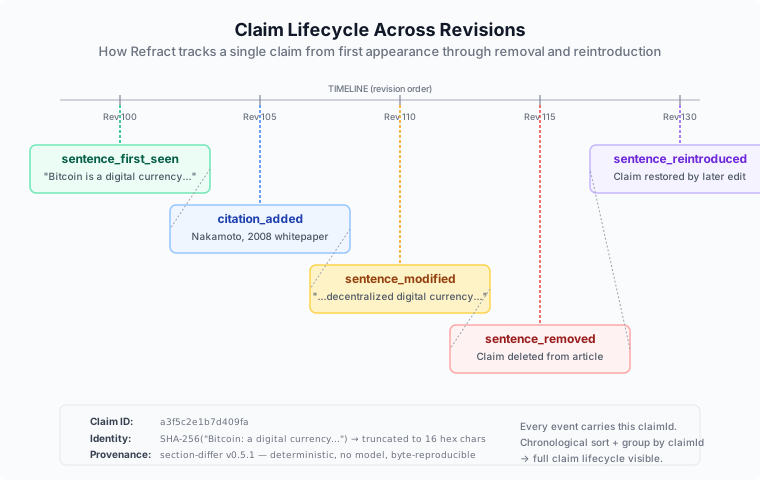
sentence_first_seen: This text has never appeared before in the revision range.sentence_removed: This text was present in the previous revision and is absent now.sentence_modified: The text changed but is similar enough (above the similarity threshold) to be considered the same sentence.sentence_reintroduced: Text that was previously removed has returned.
Source changes (citation_*)
Section titled “Source changes (citation_*)”Citations are extracted from <ref> tags in wikitext.
citation_added: A new reference was added.citation_removed: An existing reference was deleted.citation_replaced: One reference was swapped for another at the same position.
Policy signals (template_*)
Section titled “Policy signals (template_*)”Templates like {{citation needed}}, {{NPOV}}, {{BLP sources}} are Wikipedia's
dispute signals. Refract tracks them mechanically.
template_added: A template was inserted into the page.template_removed: A template was taken out.template_parameter_changed: A template's parameters were modified (e.g., date updated on a maintenance tag).
Structural changes (section_*, lead_*, page_moved)
Section titled “Structural changes (section_*, lead_*, page_moved)”section_reorganized: Sections were added, removed, or reordered.lead_promotion: Content was moved from the body into the lead section.lead_demotion: Content was moved from the lead into the body.page_moved: The entire page was renamed.
Dispute signals (revert_*, edit_cluster_*)
Section titled “Dispute signals (revert_*, edit_cluster_*)”revert_detected: An edit was reverted, detected from the edit summary matching revert patterns. Itssectionis empty.edit_cluster_detected: Multiple edits occurred within a tight time window (default: 3+ edits in 1 hour;--cluster-windowchanges it). The event spans the cluster, from its first revision to its last, and itssectionis empty.
Talk page activity (talk_*)
Section titled “Talk page activity (talk_*)”These events correlate article revisions with their associated talk pages. refract analyze and refract export emit all five from the ten talk-page edits that precede the last analyzed revision. Thread events cover the talk edits made since the first analyzed revision.
talk_page_correlated: An article revision has a nearby talk page revision.talk_thread_opened: A new discussion thread was started.talk_thread_archived: A thread was closed or archived.talk_reply_added: A reply was posted in an existing thread.talk_activity_spike: Talk page activity on one day exceeded the threshold (default: 3× the moving average;--spike-factorchanges it). The CLI looks for spikes among the ten talk-page edits that precede the last analyzed revision, within the seven days before it, so most runs emit none.
Reading patterns across events
Section titled “Reading patterns across events”Stability signal
Section titled “Stability signal”A claim that has sentence_first_seen early in the timeline, no sentence_modified
events, and is still present at the end of the revision range is stable.
Contestation signal
Section titled “Contestation signal”A claim with frequent sentence_modified events, revert_detected in its section,
and template_added with dispute templates ({{NPOV}}, {{citation needed}}) is
actively contested.
Source fragility signal
Section titled “Source fragility signal”A citation that was added and then removed within a short revision window (or was replaced multiple times) is source-fragile — the page's evidence base for that claim is unstable.
Canon change signal (Fandom wikis)
Section titled “Canon change signal (Fandom wikis)”category_removed immediately followed by category_added with a different category
in the same revision boundary is a canon reclassification. sentence_removed on a
long-standing claim followed by sentence_first_seen with different text in the same
section is a retcon.
Downstream consumption
Section titled “Downstream consumption”When building on Refract's event stream:
- Filter by
eventTypeto isolate the signal you care about (e.g., citation events for source churn analysis). - Group by
sectionto find which parts of the page are most active. - Follow one passage with
refract claim, or group the claims inrefract analyze --report, which assigns each aclaimId. Events themselves carry noclaimId. - Sort by
timestampto reconstruct the chronological sequence. - Never interpret
layervalues you didn't set —model_interpretationis for downstream use only. Refract never sets it.
The event stream is pure NDJSON — pipe it, filter it, join it, archive it.