
Complete workflow: From nothing to insight
This page ties together the parts of Refract into a single end-to-end workflow. Follow along to go from zero install to a data-backed reading of how a Wikipedia page changed.
What we're doing
Section titled “What we're doing”On 24 August 2006 the International Astronomical Union reclassified Pluto. We'll analyze the 43 revisions Wikipedia's Pluto article went through in the following hour, track one passage across them, export the events, and query them. The outputs shown are from that fixed revision range, so your run prints the same counts.
Every command below names the range with --from and --to. Without a range,
detailed and forensic analysis and export read a page's whole history.
Step 1: Zero-install analysis
Section titled “Step 1: Zero-install analysis”npx @refract-org/cli analyze "Pluto" --from 71593043 --to 71601937 --depth detailed --json | wc -l--json prints one JSON event per line; without it, analyze prints a text summary
or, in an interactive terminal, opens the explorer. Progress goes to stderr:
Analyzing "Pluto" at depth: detailed...Coverage: complete; 43 revisions (71593043 → 71601937).Correlated 43 talk page discussions. 1372Each of the 1,372 events has a type, a revision pair, a section, before/after text, and the deterministic facts that triggered it.
Step 2: Track a specific passage
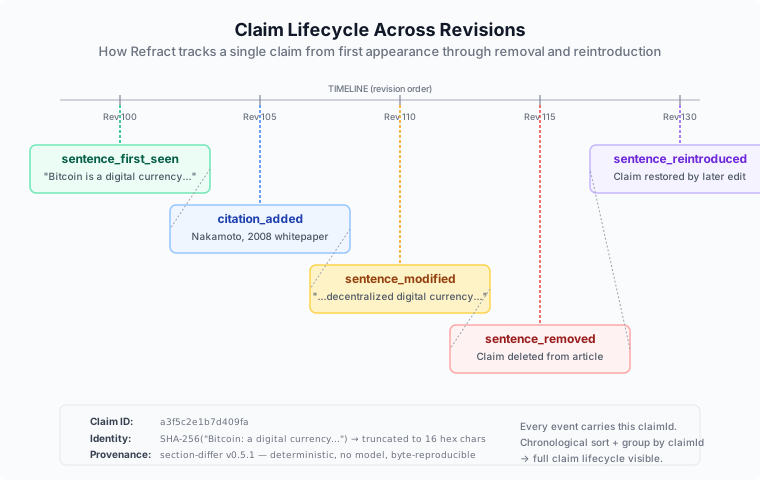
Section titled “Step 2: Track a specific passage”refract claim "Pluto" --text "ninth and smallest" --from 71593043 --to 71601937Refract prints the sentence that matched in each revision of the range, then a summary. The last lines:
[2006-08-24T14:37:04Z] EXACT MATCH (rev 71601937)  Matched text: "Pluto was considered the ninth and smallest of the planets of the Solar system by the International Astronomical Union (IAU) and the general public for much of the twentieth century, and into the early 21st."
=== Passage History Summary ===Claim ID:    f914f34dbb918e2fPage:        PlutoStatus:      contestedLatest revision: 71601937Latest match:    exactTracked "ninth and smallest" across 43 revisions. First matched within this selection at 2006-08-24T13:39:15Z (rev 71593043). Multiple changes detected; latest version at 2006-08-24T14:37:04Z (rev 71601937). …Note: Matching covers 43 fetched revisions, not the page's entire history.Note: The legacy contested label records repeated wording changes or disappearance and return, not an observed discussion dispute.
Status is present, modified, contested, absent or unknown. contested here
means the wording changed repeatedly within the range.
Without --from and --to, claim reads the latest 50 revisions (--limit changes
the number), and "first matched" is relative to those.
Step 3: Export for analysis
Section titled “Step 3: Export for analysis”refract export "Pluto" --from 71593043 --to 71601937 --format ndjson > pluto-events.jsonlThe file holds the same 1,372 events, each with an added eventId.
Step 4: Query the events
Section titled “Step 4: Query the events”duckdb -c "SELECT \"eventType\", count(*) AS cntFROM 'pluto-events.jsonl'GROUP BY \"eventType\"ORDER BY cnt DESC;"The same count with jq:
jq -r .eventType pluto-events.jsonl | sort | uniq -c | sort -rnOutput:
| eventType | cnt |
|---|---|
| wikilink_removed | 296 |
| wikilink_added | 289 |
| sentence_removed | 255 |
| sentence_reintroduced | 246 |
| section_reorganized | 97 |
| talk_page_correlated | 43 |
| sentence_modified | 30 |
| citation_added | 22 |
| citation_removed | 21 |
| template_removed | 20 |
| template_added | 20 |
| sentence_first_seen | 11 |
| talk_reply_added | 6 |
| template_parameter_changed | 4 |
| category_removed | 4 |
| category_added | 4 |
| talk_thread_opened | 2 |
| revert_detected | 1 |
| edit_cluster_detected | 1 |
Sentences were removed and reintroduced about as often (255 and 246): text was taken out and put back many times within the hour.
Find the sections with the most sentence changes:
SELECT section, count(*) AS sentence_eventsFROM 'pluto-events.jsonl'WHERE "eventType" LIKE 'sentence_%'GROUP BY sectionORDER BY sentence_events DESCLIMIT 5;jq -r 'select(.eventType | startswith("sentence_")) | .section' pluto-events.jsonl \ | sort | uniq -c | sort -rn | head -5| section | sentence_events |
|---|---|
| Charon | 93 |
| (lead) | 81 |
| Minor planet? | 50 |
| Name | 47 |
| Heliocentric distance | 36 |
revert_detected events have an empty section: a revert is detected from the edit
summary, which names no section. Group them by timestamp instead.
Step 5: Check for talk page activity
Section titled “Step 5: Check for talk page activity”The export already holds one talk_page_correlated event for each article revision
that had a talk page edit within 7 days before or 3 days after it. The detail names
the nearest talk edit's summary and its distance in hours:
jq -r 'select(.eventType == "talk_page_correlated") | .deterministicFacts[0].detail' pluto-events.jsonl \ | sort | uniq -c | sort -rn | head -3 10 time_delta_hours=0.1 talk_comment=/* Not a Planet Anymore! */ 9 time_delta_hours=0 talk_comment=/* Not a Planet Anymore! */ 7 time_delta_hours=0 talk_comment=OwnedAll 43 article revisions had a talk page edit within minutes, so the rewriting was accompanied by discussion.
The same run reports threads opened and replies added on the talk page while the article was being rewritten:
jq -r 'select(.eventType | test("talk_thread|talk_reply")) | [.eventType, .section] | @tsv' pluto-events.jsonlrefract analyze "Talk:Pluto" treats the talk page as an ordinary page and reports
its sections and sentences.
The complete picture
Section titled “The complete picture”After these 5 steps you know:
- What changed in that hour (1,372 events across 43 revisions)
- How one passage fared ("ninth and smallest" matched in the first and last revision, with repeated rewording between)
- Which sections changed most (Charon and the lead)
- Whether the talk page was active (an edit within minutes of every article revision)
- How sourcing moved (22 citations added, 21 removed)
The same commands over the same revision range produce the same events.
What to do next
Section titled “What to do next”- Automate monitoring: Set up
refract cronto re-observe daily (cron guide) - Compare across wikis: Run
refract diffon Bitcoin across English and Simple Wikipedia (cross-wiki tutorial) - Build a dashboard: Load events into DuckDB and connect to Grafana or Observable (analytics guide)
- Integrate with RAG: Use claim stability signals to filter retrieval results (downstream guide)
- Check expectations: Score events against test cases or labels (eval guide)
The same workflow for any page
Section titled “The same workflow for any page”The commands take any MediaWiki page — Wikipedia, Fandom, or a private wiki — through
--api:
refract analyze "Midi-chlorian" --api https://starwars.fandom.com/api.php --depth brief --jsonrefract claim "Midi-chlorian" --text "midi-chlorians" --api https://starwars.fandom.com/api.php --limit 10refract export "Midi-chlorian" --api https://starwars.fandom.com/api.php --from <revId> --to <revId> --format ndjson > midi-chlorian.jsonlThe output format is the same. Redirects are not followed: a redirect title, such as "Darth_Vader" on that wiki, yields the history of the redirect page itself.