#Building alone
A one-person company still has a CTO's questions, and nobody to ask them: what to set up before real users arrive, what an agent may do to production without asking you, and how you hear about a failure before a customer does. Ambit answers each one from the agent configs on your machine. Your ambit is what you, your agents and your machines can do together, and this page is about widening it from "an agent that writes code" to "an agent that helps run a product".
It does not choose your stack, review your code, or hold your secrets. Those limits are at the end.
#What stands between you and launch
npx ambit-cli goal "launch my saas"
npm install -g ambit-cli   # keeps the ambit command the rest of this page uses
The sentence is routed to Launch Ready, the launch infrastructure checklist, which is reached when six things are in place. The answer is a checklist in order: each step's setup time, what to do, and the usual ways to do it. A step you have half done says so. Sentry configured before any host is listed as configured and waiting on Hosting, instead of as something to set up again. An item is as strong as what detected or verified it: detection shows a tool is present, not that a restore has been tried.
| Step | What it gives the agent |
|---|---|
| Hosting | Deploys and logs in one place, so "ship it" and "why is it slow" are one step each |
| Production Database | The data your users create, in a managed database the agent can inspect |
| Backups | A restore point, and the habit of having tried one |
| Continuous Delivery | Agent commits go through the same CI gate as yours |
| Error Tracking | The stack trace a user hit, before they write in |
| Uptime Monitoring | Something outside your laptop that notices when the site is down |
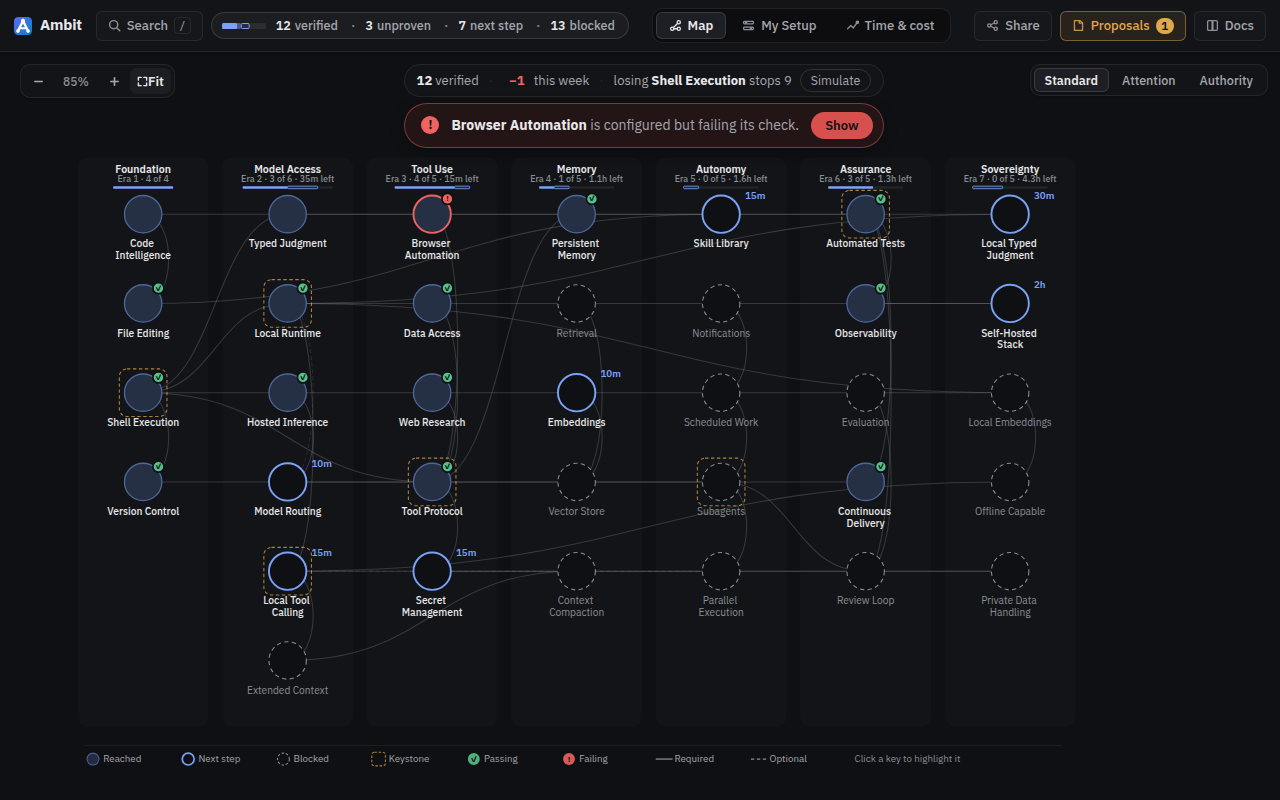
Payments, user accounts, transactional email and product analytics are not required for launch, since not every product takes money on day one. On Ambit's map they sit beside the six steps, in the two columns, or eras, named Product and Operations. Ask for any of them the same way: ambit goal "take payments", ambit goal "add login".
After each step, ambit seed reads the configs again and the list moves.
#Before an agent starts on a spec
A feature planned with Spec Kit or OpenSpec already lists its work, task by task. Ask the same question of the list:
npx ambit-cli goal --spec specs/001-team-billing
Each task is routed the way a sentence is, and the tools the plan names under Technical Context (Stripe, PostgreSQL, Playwright) count as well. The answer names the capabilities the tasks lean on, which are reached and which are failing a check, and the steps left in order with their setup time. A task about Stripe webhooks that waits on an account nobody has opened shows up here, before the agent reaches it. Tasks that name no capability are listed as routed nowhere, never guessed at. The spec is read as data: nothing in it runs and no link in it is followed.
#What an agent may do without you
Every capability in the Product and Operations eras carries defaults a careful CTO would set. The agent may read freely, must ask before anything a customer would notice, and may not do the few things that cannot be undone.
| Capability | Runs without asking | Asks first | Is refused |
|---|---|---|---|
| Hosting | read logs, deploy a preview | deploy to production, change the domain | delete the project |
| Production Database | read the schema | read rows, run a migration, write a row | drop a table, delete the database |
| Backups | list and create backups | restore one | delete one |
| Payments | list payments, create a payment link, change a price | issue a refund, delete a customer | |
| User Accounts | read or invite a user | delete a user, impersonate one | |
| Transactional Email | send a test | email one user | send a broadcast |
ambit can act:payments/issue_refund answers before an agent tries, and an agent connected over MCP asks the same question with ambit_can. In Claude Code, the ambit-gate plugin puts the decision in front of every tool call. It decides per server, so every call to your Stripe server asks first. It only narrows what Claude Code's own settings allow, and never widens it.
Budgets and approvals name the person deciding, so declare yourself once: ambit people add you. It grants nothing; it gives the trail a name to carry.
An ask-first default can be widened where a mistake is cheap. ambit authority grant hosting autonomous --scope=staging --by=you lets an agent deploy to staging without asking, while production, and any call that does not say where it is going, still asks. No grant widens a refusal, at any scope; that is what makes it one.
A ceiling on spend is one line: ambit budget set hosted-inference --amount=50 --period=month --by=you, in dollars and without a $, which the shell would read. Past it, any caller that states what it is about to spend is refused until the month turns over, whether that is ambit can --spend or an agent's ambit_can.
Claude Code sessions are the one spend recorded on their own: declare what a model costs with ambit economics price <model> --input=5 --cache-read=0.5 --output=25, in dollars per million tokens, and each session's tokens on it are charged to this budget when the session ends. A session under way is never stopped by the ceiling, and anything else counts only when its caller states it.
#When something breaks
Hearing about it first is what the Error Tracking and Uptime Monitoring steps above are for. Once you know, these say how far it goes:
ambit impact mcp:stripenames everything that stops if your Stripe server goes, before you find out by trying.ambit credentialslists what each token is holding up, so rotating one is a decision and not a surprise.ambit verifyruns every declared check, and a capability whose check fails drops out of every plan and every grant until it passes again.ambit auditis the trail of what was approved, what ran, and whether it held. Read it after a day of letting an agent work.
#What it will not do
- Choose your stack. The ways to close a step are a short list of common options, not a recommendation drawn from your situation.
- Review your code. A passing check means a tool answers. It says nothing about whether your app is correct.
- Hold your secrets. It reads which servers you have, never their keys, and sends nothing except what a command you typed sends.
- Stand in for a security review before you take money or store personal data.
- Do everything on Windows. It installs from npm and reads the agent configs there, but
ambit weighcannot start a server launched through a.cmdsuch asnpx, and a check written forshstays unverified without Git Bash or anothershon the PATH.
The guide covers installing and every command; from A to B: the seven steps is the longer walk through what Ambit makes possible.
See what your own agents can reach
Ambit reads the MCP configs of Claude Code, Cursor, OpenCode and thirteen more agents into one local map: every server, which ones work, what one more step would open, and what breaks if a piece goes.
Open the live demoa sample setup in your browser, nothing to install
On your machine: npx ambit-cli, with Node 22.18 or newer on macOS or Linux.
MIT licensed · one local SQLite file, no telemetry · on npm and in the official MCP registry